
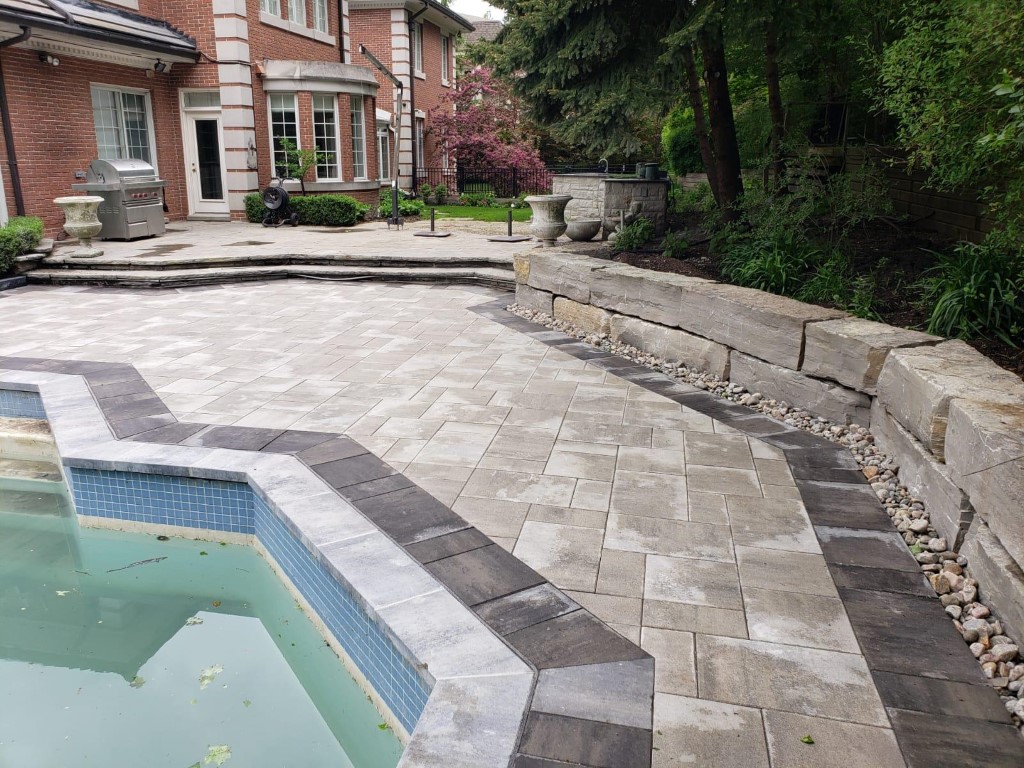
Interlocking pavers are one of the most popular and most valuable exterior upgrades for a home in Toronto and the GTA. They boost curb appeal, expand your usable outdoor space, and add real property value. They are also one of the questions we are asked most often: what does interlocking cost, and why do two quotes for the “same” interlocking projects sometimes look so different?
The honest answer is that interlocking is priced per project, not off a flat rate, because the work below the surface matters as much as the stone on top. This guide breaks down the cost factors that move the final price, the typical interlocking cost per square foot in the GTA for 2026, and how to get an accurate estimate.
Key Takeaways
- In the GTA, professionally installed interlocking pavers typically run about $32–$55 per square foot for a driveway and roughly $27-$50 per sq ft for an interlock patio or walkway, depending on material selection and site conditions.
- Material costs are only part of the price. Excavation, base preparation, grading, and site access often have a bigger impact on the total cost than the pavers themselves.
- A proper base — typically 8–12 inches of compacted gravel with the right base depth for vehicle loads — is the single biggest reason a quality paver installation costs more than a cheap one, and the reason it survives Ontario freeze-thaw cycles for decades.
- The most accurate way to price interlocking is an on-site assessment. AHS offers free, no-obligation estimates to Ontario homeowners across Toronto and the GTA.
Why Interlocking Pricing Can Vary Significantly
Interlocking (also called paving stones or hardscaping) is a system of individual pavers — concrete pavers or natural stone — laid over a compacted aggregate base and locked together with polymeric sand. Because each unit is independent, a well-built interlock surface flexes with freeze-thaw cycles instead of cracking like poured concrete, and you can lift and replace individual pavers if they are ever damaged.
Prices vary significantly because interlocking is really two products in one: the visible stone and the engineered base beneath it that provides structural integrity. A low quote almost always hides thinner base depth, less excavation, or skipped site preparation — upfront costs you “save” now and pay back later in settling, heaving, and weed growth. The cost factors below are what genuinely drive your final price, and several of them are hidden costs homeowners don’t see until they compare quotes line by line.
8 Cost Factors That Affect Interlocking Price in Toronto
These are the key factors that affect your final price, from material selection to proper excavation and base depth.
1. Paver material and material quality
The stone you choose sets your baseline material costs. As a rough materials-only guide in 2026:
- Standard concrete pavers — approximately $5–$20 per square foot. Durable, budget-friendly standard pavers for everyday driveways and patios.
- Mid-range pavers and premium materials — approximately $5–$20 per sq ft for textured, large-format slabs and premium stone from brands like Unilock, Techo-Bloc, and Permacon. These mid-range pavers balance cost and durability.
- Natural stone options — often $25+ per square foot. Flagstone, granite, and natural stone walls sit at the top for material quality and look. See our flagstone services for natural stone options.
- Permeable pavers — a premium choice that improves drainage; explore our permeable driveway option.
Material selection is where curb appeal meets budget. Not sure which stone suits your home? Our guide on how to choose interlock stones for your property walks through the trade-offs.
2. Excavation and existing surface removal
Every paver installation starts by removing the existing surface — sod, old asphalt, poured concrete, or tired pavers — and excavating the soil. Removing and hauling away an existing concrete or asphalt driveway costs more than excavating bare soil, and disposal fees in the GTA add up. Driveways that carry vehicle loads require deeper excavation than a patio, so the more material that comes out, the higher this part of the total cost will be.
3. Base preparation and base depth
This is the part homeowners never see, and contractors should never cut. An interlock patio or walkway typically needs 4–6 inches of compacted granular base, while an interlocking driveway needs roughly 8–12 inches of base depth installed in compacted layers to support vehicle loads. Proper excavation, base preparation, and high-quality polymeric sand in the joints are what deliver installation quality and long-term structural integrity — and exactly where a suspiciously low interlock installation cost is usually hiding.
4. Size of the area and square footage
Total square footage is the most obvious driver: a larger driveway or patio costs more in absolute dollars. That said, small backyard projects sometimes carry a higher cost per square foot because fixed costs — mobilizing equipment, crew setup, and disposal — are spread over fewer square feet. This is why very small jobs can feel expensive on a per sq ft basis.
5. Site access and restricted access
Interlocking relies on excavators, plate compactors, and material deliveries. Easy site access keeps labour costs efficient. Restricted access — a narrow side yard, no rear lane, tight spaces, or stairs between the street and the backyard — forces more of the work to be done by hand, wheelbarrow by wheelbarrow, which raises labour costs and the final price.
6. Grading, drainage requirements, and retaining walls
After excavation, the site is regraded so that water drains away from your home rather than toward it. Sloped properties may require retaining walls or extra fill to create a level, stable surface that serves both function and looks. Drainage requirements are not optional in the GTA — they protect your hardscape and your foundation — and on challenging or sloped properties, they are a real cost factor, sometimes adding natural stone walls or structural elements near property lines.
7. Design complexity and patterns
Simple, rectangular layouts use material efficiently and install quickly. Complex patterns, curves, circles, decorative borders, banding, multiple colours, and large format slabs increase both cutting labour and material waste. Design complexity is one of the best ways to make an outdoor space unique, but intricate detailing drives up the price per square foot for higher-end projects.
8. Application: driveway vs. patio vs. walkway
Where the pavers go changes the engineering and the price. An interlocking driveway needs the deepest base because it carries vehicle loads, so the interlocking driveway cost sits at the higher end. An interlocking patio or interlocking walkway carries foot traffic and uses a shallower base, which usually makes it more affordable per square foot. Interlocking steps and pool surrounds are more labour-intensive and priced accordingly.
Interlocking Cost Per Square Foot in the GTA (2026)
The ranges below reflect typical installed interlocking costs across Toronto and the GTA in 2026, including base preparation and labour. Because these are only prices for planning, treat them as an average price guide rather than a quote — your number depends on the cost factors above.
| Project type | Typical installed range (per square foot, 2026) |
| Interlocking driveway | $32–$55 / sq. ft. |
| Interlock patio | $32 – $55 / sq. ft. |
| Interlocking walkway | $25-$50 / sq. ft. |
| Natural stone / flagstone | $45-100+ / sq. ft. |
As a reference point, in our own heated driveway cost guide, a standard (unheated) paver driveway is noted at roughly $5-$15 per square foot for materials and installation before add-ons — a reminder that material quality and site work make the price vary significantly.
Do You Need a Building Permit for Interlocking?
For most at-grade interlocking projects — a driveway, patio, or walkway laid on grade within your property lines — a building permit is generally not required. Permit requirements may apply when a project involves significant grading near property lines, large retaining walls, or drainage changes, so confirm with your municipality in advance. (Raised structures and decks are different; see our deck permit guide.)
Is Interlocking Worth It Compared to Poured Concrete?
Interlocking usually has higher upfront costs than plain asphalt and is comparable to or slightly above poured concrete. The payoff is long-term value: you can replace individual pavers if one is damaged, the surface resists freeze thaw cracking, and quality paver installation lasts for decades with simple maintenance — making interlocking one of the most valuable exterior upgrades for property value. Poured concrete, by contrast, tends to crack along the slab and is far harder to repair invisibly.
How to Get an Accurate Interlocking Estimate
Because so much depends on the existing surface, base depth, and site access, no honest contractor can give a firm price over the phone. An accurate estimate follows an on-site visit and a detailed breakdown that should clearly spell out:
- The paver brand, style, and colour, plus the high-quality polymeric sand used to lock joints and limit weed growth.
- The excavation depth and compacted base depth (in inches) for your specific application and vehicle loads.
- Grading, drainage requirements, and any retaining walls or fill needed on sloped properties.
- Edge restraints, cutting for complex patterns or decorative borders, and the total square footage.
- Cleanup, disposal, and the workmanship warranty.
Compare quotes factor by factor, not by bottom-line total cost — that is how you spot hidden costs and save money on the right project rather than the cheapest one. For more on vetting a contractor, see our guide to the best landscaping contractors in Toronto.
Why Ontario Homeowners Choose AHS Landscaping
Action Home Services has spent over a decade building interlocking projects across Toronto and the GTA, with 6,000+ completed projects, 2,000+ five-star reviews, and Landscape Ontario awards. We are fully licensed, insured, and WSIB-compliant; every project is managed in-house to the highest standards of installation quality, and our paver installation is backed by a written workmanship warranty. Browse recent installations in our project gallery or explore our full range of landscaping services.
Get A Quote for Your Next Outdoor Project
Ready to price your project properly? Book a free, no-obligation on-site estimate, and our team will assess your site, recommend the right material selection and base depth, and give you a transparent, detailed breakdown. Call AHS at (647)483-6211 or request your free estimate online.
Frequently Asked Questions
How much does interlocking cost per square foot in Toronto in 2026?
In 2026, professionally installed interlocking pavers in the GTA typically cost about $32–$55 per square foot for a driveway and roughly $32–$55 per sq ft for an interlock patio or walkway. Your final price depends on material selection, the extent of excavation and base preparation required, site access, and design complexity.
Why is one interlocking quote so much cheaper than another?
The most common reason is base depth. A lower interlock installation cost usually means less excavation and a thinner base, which costs less up front but is far more likely to settle, shift, or heave within a few winters. Always compare the excavation depth and compacted base depth, not just the cost per square foot.
Is interlocking cheaper than poured concrete?
Interlocking has higher upfront costs than plain asphalt and is comparable to or slightly above poured concrete. Its advantage is value over time: you can replace individual pavers, it resists freeze thaw cracking, and it lasts longer with simple maintenance, which often makes it more economical across the life of the surface.
What factors most affect the interlocking price?
The biggest cost factors are material quality (standard concrete pavers vs. premium stone or large format slabs), the amount of excavation and base preparation required, site access, grading and drainage requirements including retaining walls, and design complexity. Material costs alone rarely tell the whole story of the total cost.
Does interlocking add property value?
Yes. Quality interlocking improves curb appeal and expands usable outdoor space, both attractive to buyers. A professionally installed, well-drained driveway or patio is widely considered one of the most valuable exterior upgrades for property value.
How long does an interlocking project take?
Most residential interlocking projects in the GTA are completed within 3–7 days, weather permitting. Larger jobs with deeper excavation, retaining walls, or complex patterns take longer.