

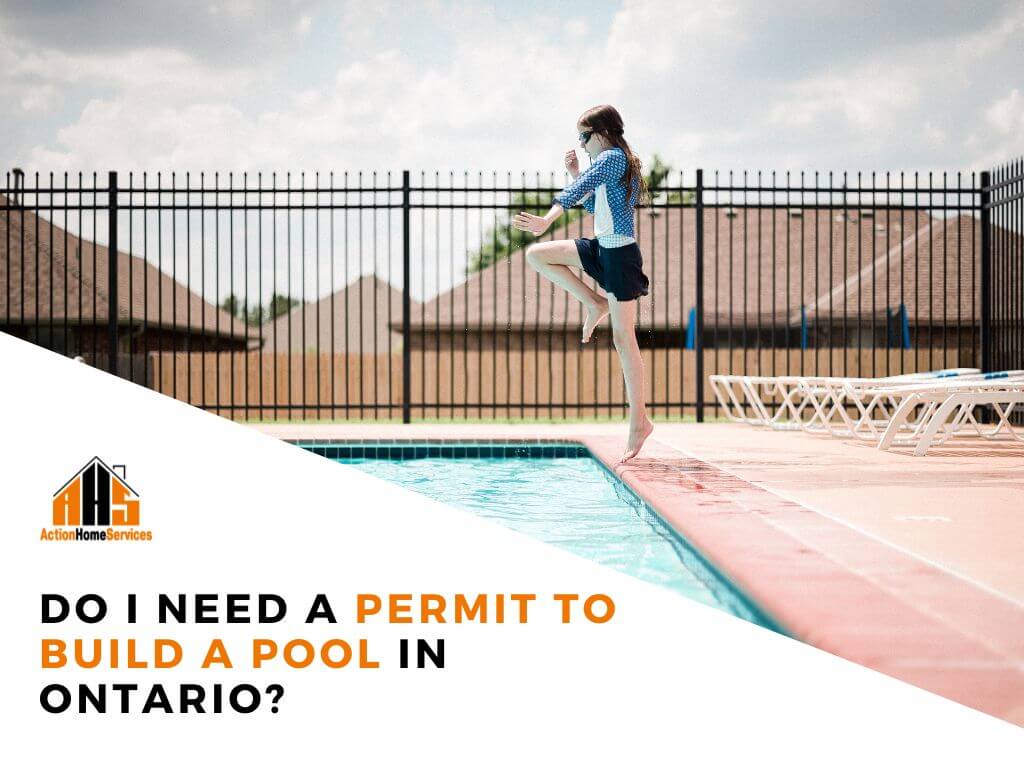
Turning your rear yard into a backyard oasis with a new pool is exciting — but before any construction begins, there is paperwork to sort out. Safety regulations have tightened, municipal bylaws are enforced more strictly, and skipping a step can mean fines, a stop-work order, or not being allowed to fill your pool. Here's a clear breakdown of the permit requirements for swimming pools in Ontario in 2026 — what's needed, who issues each permit, and how the process works for Ontario homeowners, noting that a pool enclosure permit is typically required in Ontario municipalities before installing a pool.
This guide is provided by Action Home Services, a licensed, insured, WSIB-compliant team of pool builders and landscaping professionals with 6,000+ projects across the GTA. Because zoning laws and specific requirements vary by city, we have flagged where you should always confirm locally.
Key Takeaways
- In most Ontario municipalities, you do not need a building permit for the in-ground pool shell itself — but you almost always need a pool enclosure permit and zoning approval before you start construction.
- A pool enclosure permit is mandatory with no exceptions: you cannot fill an in ground or above ground pool until the city inspects and approves compliant pool fencing with self latching gates.
- In Toronto, the enclosure must be at least 1.2 m in height for a single residential property (1.5 m for multi-residential/non-residential), fully surround the pool area, and use self-closing and self-latching gates.
- Setback rules from lot lines and the house, plus Conservation Authority (TRCA) approval in regulated areas and an ESA permit for pool equipment, may also apply.
- AHS manages the entire process — pool design, permit application, and inspections — for our pool installation clients.
Do You Need a Building Permit to Build a Pool in Ontario?
Here is the part that surprises many homeowners: under the Ontario Building Code, the swimming pool structure itself usually does not require a building permit. What is strictly regulated is safety around the pool. So the permits you actually need are tied to the pool enclosure (fencing), zoning compliance, and any associated electrical, gas, or drainage work for your pool equipment.
In practice, for a typical residential in-ground pool — whether you choose fiberglass pools, vinyl liner pools, or concrete — you should expect to obtain a zoning review and a pool enclosure permit at minimum. Larger projects and certain cities may have additional specific requirements. Always confirm with your local building department, as each city sets its own municipal bylaws in addition to provincial regulations.
The Permits and Approvals You May Need
1. Zoning review and setback rules
Before a proposed pool is approved, the city checks that it complies with local zoning laws — setback requirements from property lines and lot lines, the house, septic systems, and easements, plus lot-coverage limits in residential zones. A plot plan (site plan) shows your pool’s location on the property. Getting setback rules wrong is one of the most expensive mistakes, because a pool in the wrong space may have to be moved.
2. Pool enclosure (fence) permit
This is the permit nearly every homeowner needs, and it is mandatory before construction. It governs the fence or barrier — your pool enclosure — that surrounds the pool area. The city reviews your proper fencing plan, issues the permit, and later inspects the finished enclosure before you are allowed to add water. If you have an existing pool enclosure you are modifying, a permit generally still applies.
3. Electrical permit (ESA) for pool equipment
Pumps, heaters, and lighting are pool equipment that involve electrical work and must be done by a licensed electrician and permitted through the Electrical Safety Authority (ESA). Water and electricity demand proper bonding and grounding — this is a core safety feature, not a formality.
4. Conservation Authority approval (if applicable)
If your property sits within a regulated area — near a ravine, valley, watercourse, wetland, or floodplain — you may need approval from your local Conservation Authority, such as the TRCA, before any ground is broken. This protects sensitive land and can affect where and how the pool is built.
5. Plumbing, gas, and deck permits (project-dependent)
Gas lines for a pool heater, certain plumbing connections, and a raised pool deck may require their own permits. Decks more than 60 cm above grade need a building permit of their own — see our deck permit guide.
Pool Fencing and Enclosure Rules in Toronto (2026)
Toronto’s pool fencing requirements come from Toronto Municipal Code Chapter 447 (Fences). The current safety regulations for a swimming pool enclosure include:
- Minimum height — at least 1.2 metres for a single residential property; at least 1.5 metres for multi-residential or non-residential properties.
- Full enclosure — the barrier must completely surround the pool with no openings other than a gate. A standard chain-link fence may qualify if it meets the height and non-climbable requirements.
- Self-closing and self-latching gates — every gate must be self closing and self latching, with the latch placed out of reach of young children.
- Non-climbable design — the enclosure must be at least 1 m from anything outside it that could aid climbing, and climbable elements are restricted between 100 mm and 1.2 m above grade on the outside face.
- Inspection before water — you cannot fill the pool or allow water to collect until the City inspects and confirms the enclosure complies.
Other GTA cities (Vaughan, Markham, Richmond Hill, Mississauga, Oakville) set their own municipal bylaws with similar but not identical numbers, so confirm locally. Our fencing and railings teams build compliant pool fencing as part of a complete pool installation, and automatic pool covers provide an additional layer of safety. The right safety features and pool size determine how your enclosure is designed.
The Pool Permit Process Step by Step
- Pool design and zoning check — your contractor prepares a plot plan and confirms setback requirements and zoning laws.
- Submit the permit application — zoning review and pool enclosure permit (plus ESA, gas, or conservation approvals as needed).
- Permit issued — the city reviews and approves; only then can construction and excavation begin.
- Construction — the pool and a compliant enclosure are built to the approved plans within your property lines.
- Final enclosure inspection — the City inspects the proper fencing and self-latching gates.
- Fill and enjoy — once the enclosure passes, you can fill the pool and open your backyard oasis.
In Toronto, pool enclosure questions go to Municipal Licensing & Standards. The entire process is smoother when experienced professionals handle it — see the swimming pool permit drawings service, which produces the documentation cities require.
What Happens If You Skip the Permits?
Building without the required permits is a costly gamble. Cities can issue stop-work orders, levy fines, and refuse to let you fill the pool until compliant pool fencing passes inspection. If a pool is built in the wrong location for zoning, you may be ordered to relocate or remove it — a huge addition to your construction costs. Because tighter pool-safety enforcement has pushed up compliance costs across the GTA, cutting corners rarely saves money. These trends are highlighted in the article on how new Toronto regulations are increasing backyard pool costs.
How AHS Makes Pool Permitting Easy
Permits, drawings, zoning, and inspections are exactly the work a full-service builder should take off your plate so you can focus on your dream pool. Action Home Services designs and installs concrete pools, fiberglass pools, and vinyl liner pools across the GTA, prepares the required permit drawings, and coordinates approvals so your project stays compliant from day one.
Because each municipality enforces its own bylaws, having one team manage every approval helps prevent costly delays and surprises. We also install hot tubs and spas, which carry their own enclosure rules, and manage the full pool installation from start to finish.
Build Your Pool the Right Way
Thinking about a backyard pool? Let AHS handle the pool design, permits, and construction so your project is safe, compliant, and stress-free. Call (647)483-6211 or request a free estimate. Planning your budget too? Read our inground pool cost in Ontario guide.
Frequently Asked Questions
Do I need a building permit for an inground pool in Ontario?
In most Ontario municipalities, the in-ground pool shell itself does not require a building permit under the Ontario Building Code, but you do need a pool enclosure permit and zoning approval before you start construction. Electrical work for pool equipment needs an ESA permit, and properties in regulated areas may need Conservation Authority approval. Always confirm the specific requirements with your local building department.
How high does a pool fence have to be in Toronto?
In Toronto, a swimming pool enclosure must be at least 1.2 metres in height for a single-residential property and at least 1.5 metres for multi-residential or non-residential properties. It must fully surround the pool area with self-closing, self-latching gates and be set back from anything that could be used to climb on.
Do above ground pools need a permit in Ontario?
An above ground pool still requires compliant pool fencing and is subject to the same enclosure, self-latching gate, and setback rules, so a pool enclosure permit generally applies. Some cities treat the pool wall as part of the barrier if it meets the height and non-climbable requirements — confirm with your municipal bylaws.
What are the setback rules for a pool in Ontario?
Setback requirements vary by municipality, but a pool must be placed a minimum distance from property lines, lot lines, the house, and septic systems, and must respect lot-coverage limits in residential zones. Your contractor confirms these on a plot plan during the zoning review before you build.
Do hot tubs and spas need a pool enclosure?
Many cities apply pool-enclosure and pool fencing rules to hot tubs and spas, though some allow a lockable, compliant hard cover instead of a full fence. Because this varies, check your local municipal bylaws before you install a hot tub or spa.
Who is responsible for getting pool permits — me or my contractor?
Legally, the property owner is responsible, but reputable pool builders manage the entire process for you, including drawings, permit applications, and inspections. AHS handles permitting and approvals as part of our pool installation service.